Anomaly Scan and Fetal Growth Scan: Cost, Best Week and What to Expect
Pregnancy ultrasound scans help monitor your baby’s development and check important aspects of pregnancy. An anomaly scan examines the baby’s physical development and checks for certain structural conditions. A fetal growth scan measures the baby’s size, weight estimate, position and other features to assess growth.
Both scans provide useful information at different stages of pregnancy. Your obstetrician may recommend one or both scans depending on your pregnancy stage, medical history and previous scan results.
The cost of pregnancy ultrasound scans in Dubai depends on the type of scan, the tests included and the healthcare provider. Additional scans, such as 3D or 4D pregnancy ultrasound and Doppler ultrasound, provide different types of information.
Read this complete guide to learn about anomaly scans and fetal growth scans, including the best week, procedure, cost factors, preparation and what to expect from the results.
What Is an Anomaly Scan?
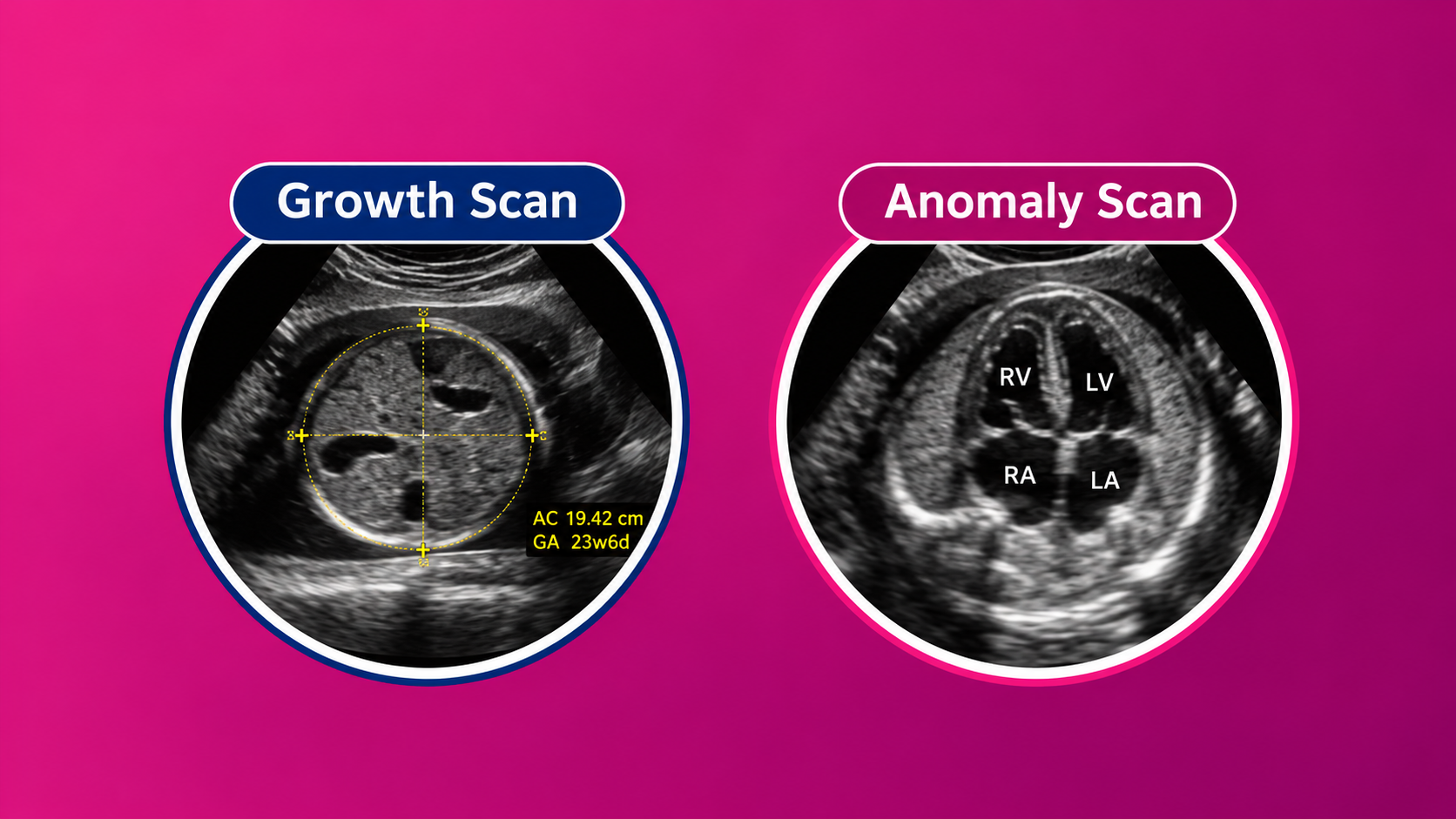
An anomaly scan is a detailed pregnancy ultrasound usually performed between 18 and 22 weeks. It is also called the mid-pregnancy scan or 20-week scan.
The scan examines the baby’s physical development and checks for certain structural abnormalities. It also assesses the placenta, amniotic fluid and other features of the pregnancy.
During the scan, the sonographer examines different parts of the baby’s body, including:
- Brain and head
- Face and lips
- Spine
- Heart and major blood vessels
- Stomach
- Kidneys
- Bladder
- Arms and legs
- Abdominal wall
The scan also checks the position of the placenta and the amount of amniotic fluid.
An anomaly scan can identify several structural conditions, but it cannot detect every possible birth condition or genetic disorder. Some conditions develop later in pregnancy or are not visible on ultrasound.
What Is the Best Week for an Anomaly Scan?
The recommended time for an anomaly scan is generally between 18 and 22 weeks of pregnancy. This period allows the sonographer to examine the baby’s major organs and body structures in detail.
Pregnancy Week | Purpose |
18 weeks | Detailed examination of the baby’s organs and body structures |
19 weeks | Assessment of physical development and major structures |
20 weeks | Commonly recommended time for the anomaly scan |
21 weeks | Detailed assessment of anatomy and placenta |
22 weeks | Scan completion if an earlier examination was not possible |
Your doctor may recommend a different appointment time depending on your pregnancy history and clinical requirements.
If the baby is in a position that makes it difficult to examine certain structures, you may need to return for additional images. This does not automatically indicate a problem with the baby’s development.
What Is a Fetal Growth Scan?
A fetal growth scan is an ultrasound examination used to assess the baby’s size and growth during pregnancy. It is usually performed during the second or third trimester when your doctor needs additional information about the baby’s development.
The scan measures different parts of the baby’s body and uses these measurements to estimate fetal weight.
A fetal growth scan commonly checks:
- Head circumference
- Biparietal diameter, which measures the width of the baby’s head
- Abdominal circumference
- Femur length, which measures the thigh bone
- Estimated fetal weight
- Baby’s position
- Amniotic fluid levels
- Placental position
The measurements are compared with standard fetal growth charts to assess whether the baby is growing within the expected range.
A growth scan can help identify babies who are smaller or larger than expected for their gestational age. Your doctor may also recommend additional monitoring if the measurements or other findings require further assessment.
What Is the Best Week for a Fetal Growth Scan?
The timing of a fetal growth scan depends on the reason for the examination. Many growth assessments take place during the third trimester, often between 28 and 36 weeks.
Pregnancy Week | Purpose |
24 to 28 weeks | Growth assessment when clinically recommended |
28 to 32 weeks | Assessment of fetal size and development |
32 to 36 weeks | Monitoring growth, estimated weight and amniotic fluid |
36 to 38 weeks | Additional assessment when required by the obstetrician |
Not every pregnant woman needs multiple growth scans. Your doctor will recommend the timing based on your pregnancy progress, medical history, previous ultrasound findings and risk factors.
If there are concerns about fetal growth, the doctor may recommend repeat scans to compare measurements over time. These scans are usually spaced far enough apart to assess meaningful changes in growth.
Anomaly Scan vs Fetal Growth Scan: What Is the Difference?
Both scans use ultrasound technology, but they have different purposes.
Feature | Anomaly Scan | Fetal Growth Scan |
Main purpose | Examine the baby’s anatomy | Assess the baby’s growth and size |
Common timing | 18 to 22 weeks | Usually during the second or third trimester, depending on clinical need |
Main focus | Organs and body structures | Head, abdomen, thigh bone and estimated weight |
Checks placenta | Yes | Yes |
Checks amniotic fluid | Yes | Yes |
Detects structural abnormalities | Screens for certain structural conditions | Not its primary purpose |
Estimates fetal weight | Not the main focus | Yes |
An anomaly scan provides a detailed examination of the baby’s physical structures. A fetal growth scan focuses on the baby’s size, weight estimate and development over time.
Your obstetrician can advise which scan is appropriate for your stage of pregnancy.
Anomaly Scan and Fetal Growth Scan Cost in Dubai
A pregnancy ultrasound at Health 24/7 costs AED 300. This listed price is the applicable reference for anomaly scan and fetal growth scan enquiries.
Ultrasound Type | Price (AED) |
|---|---|
Anomaly Scan | 300 |
Fetal Growth Scan | 300 |
3D or 4D Pregnancy Ultrasound | 700 |
Doppler Ultrasound | 600 |
For a detailed examination of your baby’s development, you can book a pregnancy ultrasound for AED 300. A 3D or 4D scan costs AED 700, while a Doppler ultrasound costs AED 600 for assessing blood flow during pregnancy.
How Is an Anomaly or Fetal Growth Scan Done?
Anomaly and fetal growth scans use ultrasound technology to create images of the baby inside the uterus. The procedure is generally straightforward and does not involve radiation.
The examination usually follows these steps:
Step 1: Preparation
You may be asked to lie comfortably on the examination bed. The sonographer may ask about your pregnancy week and previous ultrasound reports.
Step 2: Applying Ultrasound Gel
A small amount of gel is applied to your abdomen. This helps the ultrasound probe move smoothly and improves contact with the skin.
Step 3: Scanning the Baby
The sonographer moves the ultrasound probe over your abdomen to capture images of the baby. The examination includes the measurements and structures required for the requested scan.
Step 4: Taking Measurements
For an anomaly scan, the sonographer examines the baby’s major organs and body structures. For a growth scan, measurements such as head circumference, abdominal circumference and femur length are recorded.
Step 5: Report Preparation
The captured images and measurements are reviewed, and a report is prepared. Your doctor can explain the findings and advise whether additional monitoring is needed.
How to Prepare for a Pregnancy Ultrasound
Most pregnancy ultrasound scans do not require complicated preparation. However, the instructions can vary depending on the scan type and pregnancy stage.
Some general preparation tips include:
- Follow the appointment instructions provided by the healthcare centre.
- Carry previous pregnancy ultrasound reports.
- Know your current pregnancy week.
- Wear comfortable clothing that allows easy access to your abdomen.
- Follow instructions about drinking water or having a full bladder.
- Inform the sonographer about any discomfort or relevant medical concerns.
- Arrive on time for your appointment.
A full bladder is sometimes requested for earlier pregnancy scans. It is generally not required for most later pregnancy ultrasound examinations.
Always follow the instructions given by your healthcare provider.
How Long Does a Pregnancy Ultrasound Take?
The duration depends on the type of scan and the baby’s position.
An anomaly scan usually takes longer because the sonographer needs to examine several organs and body structures in detail. A fetal growth scan focuses on specific measurements and generally takes less time.
A 3D or 4D scan can also take longer if the baby’s position makes it difficult to capture clear images.
If the sonographer cannot obtain all the required images during the appointment, you may be asked to return for additional scanning.
What Happens If an Anomaly Scan Shows an Abnormal Finding?
An abnormal or unclear finding during an anomaly scan does not always mean that the baby has a serious condition.
Some findings require closer examination, while others can be related to the baby’s position or the limitations of ultrasound imaging.
Your doctor may recommend:
- A repeat ultrasound scan
- A detailed examination by a specialist
- Fetal echocardiography to examine the baby’s heart
- Additional diagnostic tests
- Follow-up appointments to monitor the pregnancy
The next step depends on the specific finding and your pregnancy history. Your obstetrician will explain the report and discuss any further examinations required.
For more details about convenient pregnancy scans at home, read our guide to At Home Ultrasound for Pregnancy
What Happens If the Baby Is Measuring Smaller or Larger Than Expected?
A fetal growth scan can show whether the baby’s measurements are within the expected range for the pregnancy week.
If the baby measures smaller than expected, the doctor may assess placental blood flow, amniotic fluid levels and other growth measurements. Additional scans can help monitor changes over time.
If the baby measures larger than expected, your doctor may review factors such as maternal health, blood sugar levels and previous pregnancy history.
Estimated fetal weight is calculated using ultrasound measurements. It is not an exact measurement of the baby’s actual weight.
Your obstetrician will interpret the results along with other clinical information before recommending any action.
Where Can You Get a Pregnancy Ultrasound in Dubai?
Pregnancy ultrasound scans are available through diagnostic centres and healthcare providers in Dubai.
When choosing a pregnancy ultrasound service, consider:
- Availability of the required scan type
- Qualified sonographers and radiology professionals
- Appropriate ultrasound equipment
- Clear scan reports
- Convenient appointment scheduling
- Transparent pricing
- Access to follow-up examinations when required
Health 24/7 helps patients arrange healthcare services in Dubai, including pregnancy-related diagnostic support. Contact the team to confirm the available ultrasound services, appointment details and current pricing.
Why Is Pregnancy Ultrasound Monitoring Important?
Pregnancy ultrasound examinations provide information about the baby’s development and the progress of pregnancy.
Depending on the scan type, ultrasound can help:
- Examine the baby’s physical structures
- Assess fetal growth and estimated weight
- Check the position of the placenta
- Evaluate amniotic fluid levels
- Assess blood flow when Doppler is recommended
- Identify findings that need further medical evaluation
- Support pregnancy monitoring and clinical decisions
Each scan has a specific purpose. Your obstetrician will recommend the appropriate examinations based on your pregnancy stage and medical needs.
Book Your Pregnancy Ultrasound with Health 24/7
Anomaly scans, fetal growth scans and other pregnancy ultrasound examinations provide important information about your baby’s development.
Whether your doctor has recommended a detailed anomaly scan, a fetal growth assessment or a Doppler ultrasound, choosing the correct examination at the recommended pregnancy stage is important.
Health 24/7 helps you arrange pregnancy-related diagnostic services in Dubai. Contact the team to check available scan options, appointment timings and current prices.
Frequently Asked Questions About Anomaly and Fetal Growth Scans
What is the difference between an anomaly scan and a growth scan?
An anomaly scan examines the baby’s organs and physical structures, usually between 18 and 22 weeks. A fetal growth scan measures the baby’s size, estimated weight, position and other growth indicators. Both scans provide different information about pregnancy.
Can an anomaly scan detect all birth defects?
No. An anomaly scan can identify several structural abnormalities, but it cannot detect every birth defect, genetic condition or developmental problem. Some conditions are not visible during ultrasound examinations.
Is an anomaly scan necessary during pregnancy?
An anomaly scan is a standard part of pregnancy care in many healthcare settings. It provides a detailed assessment of the baby’s anatomy. Your obstetrician can explain its purpose and recommend the appropriate timing.
Can I have a growth scan after 32 weeks?
Yes. A fetal growth scan can be performed after 32 weeks when your doctor recommends it. The timing depends on your pregnancy progress, previous scan findings and medical requirements.
Does a fetal growth scan show the baby’s exact weight?
No. A fetal growth scan provides an estimated fetal weight based on ultrasound measurements. The actual birth weight can be different because ultrasound weight calculations have a margin of error.
Is a Doppler ultrasound required for every pregnant woman?
No. Doppler ultrasound is generally recommended when the doctor needs to assess blood flow, placental function or specific pregnancy concerns. It is not routinely required for every pregnancy.
Can a 3D or 4D scan replace an anomaly scan?
No. A 3D or 4D pregnancy ultrasound provides three-dimensional images and real-time views of the baby’s movements. It does not replace the detailed anatomical assessment performed during a medical anomaly scan.
Does an anomaly scan hurt?
No. An anomaly scan is a non-invasive ultrasound examination. The sonographer moves a probe over your abdomen to capture images of the baby. You may feel slight pressure from the probe, but the procedure is generally comfortable.
Do I need a full bladder for an anomaly scan?
Usually, a full bladder is not required for a routine anomaly scan performed during the second trimester. Preparation instructions can vary, so follow the guidance provided by your healthcare centre.
How long does it take to receive a pregnancy ultrasound report?
The report turnaround time depends on the scan type, examination requirements and healthcare provider. Ask the centre about the expected reporting time when booking your appointment.
Can a fetal growth scan identify growth restriction?
A fetal growth scan can identify measurements that suggest the baby is smaller than expected for the pregnancy week. Your doctor may recommend additional scans, Doppler assessment or other monitoring to evaluate the findings.
How much does an anomaly scan cost in Dubai?
The cost depends on the healthcare provider and the services included in the examination. Contact Health 24/7 to confirm the current anomaly scan price and available appointment options.